The Truck Won't Run
There are children who grow up learning multiplication tables and baseball scores.
And there are children who grow up learning moods.
I was one of the second kind.
In a house where anger could arrive before breakfast, you learned to study the atmosphere the way a farmer studies the sky. You learned the weight of footsteps in the hallway. You learned the tone of a sigh. You learned the difference between silence that meant peace and silence that meant a storm was building.
My strategy was perfection.
If I could control the details, maybe I could control the outcome. I scrubbed baseboards until they were spotless. I wiped counters that were already clean. I made sure nothing was out of place. When I carried Dad’s coffee into his room each morning, I paid attention to the temperature like it was a life-or-death calculation. Too hot, and it might irritate him. Too cool, and it might disappoint him.
I would stand at that door every morning with fear sitting in my stomach. Before I ever turned the knob, I was bracing for impact. I wasn’t thinking like a child. I was thinking like a soldier entering uncertain territory.
My older brother Gene chose a different path.
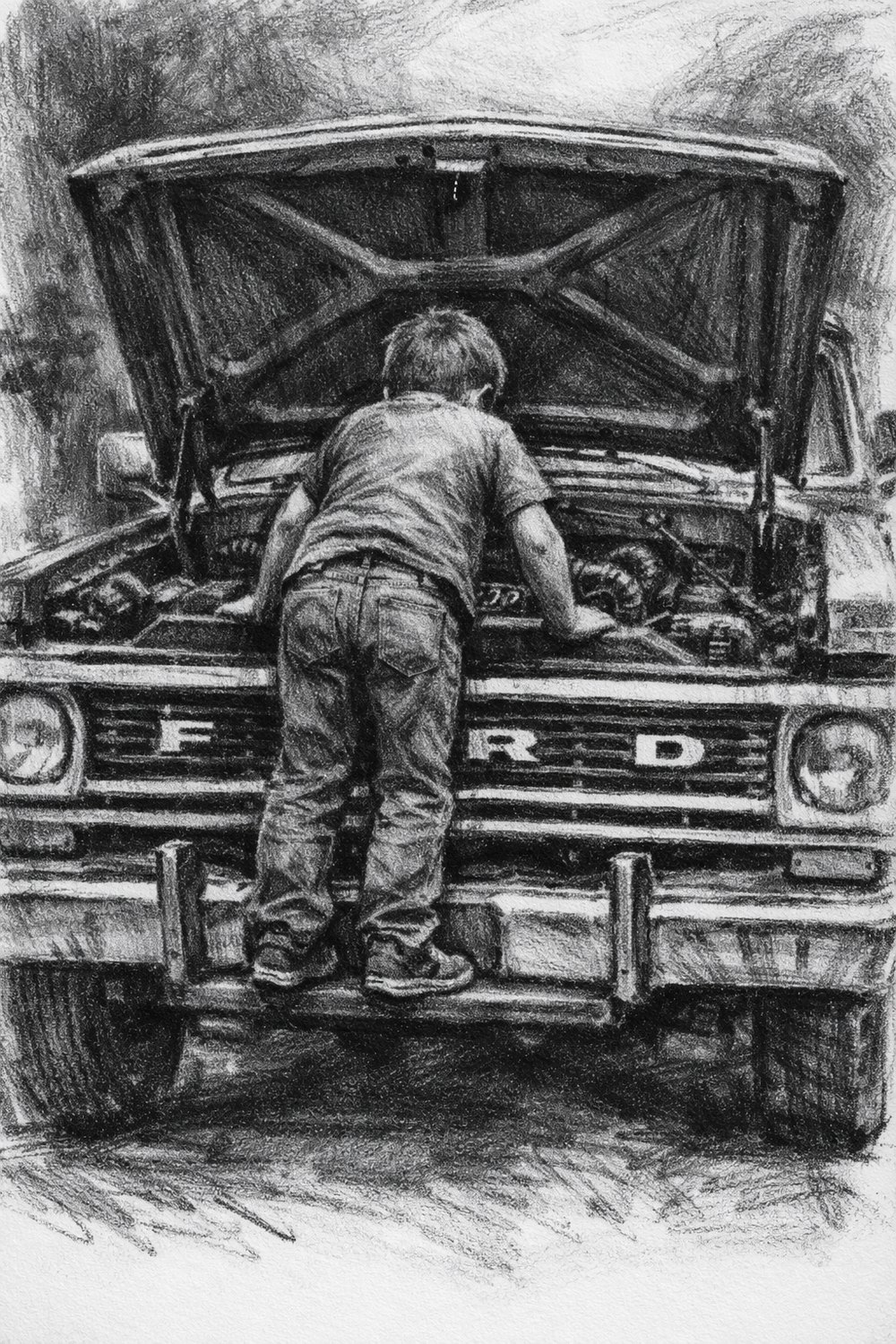
Gene was mechanically wired — an engine man. I was mechanical too, but in the way of building and application. Gene understood systems. He understood cause and effect. And somewhere along the way, he realized something powerful: if the truck didn’t run, the morning changed.
At night, after Dad came home, Gene would quietly sabotage the truck. Nothing dramatic. Just enough so that when the key turned in the morning, the engine would cough, hesitate, and refuse.
Dad would assume neighborhood kids had messed with it.
And then Gene would step in.
He would slide under the hood like a quiet hero, diagnose the “problem,” and repair what he himself had undone. The engine would roar back to life. Dad’s frustration would redirect into relief. Gene would earn praise, maybe even gratitude. More importantly, he earned space. He earned time outside in the cold air instead of inside the heat of rising anger.
Winter mornings made everything heavier. Framing houses in freezing temperatures is miserable before the work even begins. When a man is already dreading the cold, a truck that won’t start feels like betrayal. That frustration has to land somewhere.
Gene learned to catch it before it landed on us.
Looking back, I don’t see rebellion in what he did. I see survival. I see intelligence. I see two boys, each trying in their own way to manage a world they could not control.
I tried to make the world perfect.
Gene tried to redirect the storm.
Both of us were improvising. Both of us were adapting. Both of us were overcoming — not on some battlefield overseas, but in a small house where mornings mattered.
Children in hard homes grow up early.
They become students of human nature. They learn systems. They learn strategy. They learn how to read danger before it fully appears.
The truck wouldn’t run.
And because of that, sometimes we could breathe.
Nuggets of Wisdom
- Children in unstable homes often develop extraordinary awareness long before they develop peace.
- Perfectionism is sometimes a shield built by a frightened heart.
- Intelligence born in survival can later become strength in leadership.
- Improvisation learned in childhood can become resilience in adulthood.
- Not all heroes wear uniforms; some quietly turn wrenches in the dark.
Proverbs
- “The wise fear the Lord and shun evil, but a fool is hotheaded and yet feels secure.” — Proverbs 14:16
- “The words of the reckless pierce like swords, but the tongue of the wise brings healing.” — Proverbs 12:18
- “Whoever sows injustice reaps calamity, and the rod they wield in fury will be broken.” — Proverbs 22:8
This story has a workbook — how to use it with the person across from you, and the point of it. Read the workbook for The Truck Won't Run · All the workbooks.