NUCLEAR POLICY
Are We Creating Another Iran?
On July 22, 2026, the United States and Saudi Arabia signed a civilian nuclear-cooperation agreement, commonly called a “123 Agreement,” together with a separate bilateral safeguards agreement. The Department of Energy described it as the legal foundation for a decades-long, multibillion-dollar partnership that would help Saudi Arabia develop nuclear power while providing opportunities for American companies.
There are legitimate reasons for Saudi Arabia to want nuclear energy. Its cities, industries, desalination plants, and expanding technology sector require enormous amounts of electricity. Nuclear power could allow the kingdom to meet some of that demand without burning as much oil. American participation could create jobs, keep American companies competitive, and give the United States more influence over safety and nonproliferation standards than it might have if Saudi Arabia turned entirely to another supplier.
The nuclear power plant is not the central problem.
The question is whether Saudi Arabia will be permitted to enrich uranium on its own soil.
Most commercial nuclear reactors use uranium enriched to approximately 3 to 5 percent uranium-235. Nuclear weapons generally require uranium enriched to more than 90 percent. Those are dramatically different concentrations, and possessing a civilian reactor does not mean possessing a nuclear bomb. But the centrifuges and technical knowledge used to produce low-enriched reactor fuel can also be used, if a government makes that decision and defeats or removes the safeguards, to continue enriching uranium toward weapons-grade levels.
Saudi Arabia does not need a domestic enrichment program merely to produce nuclear electricity. It can purchase low-enriched reactor fuel from established international suppliers, operate the reactors under inspection, and arrange for the used fuel to be removed or securely managed. The United Arab Emirates accepted the central safeguard in that approach in its nuclear agreement with the United States: civilian nuclear power without domestic uranium enrichment or spent-fuel reprocessing. That commitment became known as the nonproliferation “gold standard.”
The full Saudi agreement and its safeguards must therefore be examined carefully. The administration’s public announcement did not disclose enough detail to answer every question. The Associated Press reported that the agreement could open a path to a Saudi enrichment facility after a joint American-Saudi study. That is not proof that Saudi Arabia has received weapons-grade material, a nuclear weapon, or immediate authority to produce either one. It is, however, enough to ask why the same clear prohibition accepted by the United Arab Emirates was not required from Saudi Arabia.
That question becomes more important because Crown Prince Mohammed bin Salman has publicly stated what Saudi Arabia would do if Iran acquired a nuclear weapon. In 2018, he said, “without a doubt if Iran developed a nuclear bomb, we will follow suit as soon as possible.” In 2023, he repeated the point more simply: “If they get one, we have to get one.”
Those statements do not prove that Saudi Arabia presently intends to violate a civilian agreement. They do establish that its de facto ruler has publicly contemplated acquiring a nuclear weapon under circumstances he considers threatening.
History Corrects the Comparison
Saudi Arabia is not another Iran, and the two governments should not be described as though they have identical histories.
Saudi Arabia has remained under the Al Saud monarchy since the modern kingdom was established in 1932. It has endured internal power struggles, terrorist attacks, regional wars, succession disputes, and challenges to royal authority, but its government has not been repeatedly overthrown since 1980. Iran’s monarchy was overthrown in 1979, but the Islamic Republic created by that revolution has also remained in power for more than four decades.
The danger is not that either government changes every few years. The danger is that alliances, leaders, interests, and regional conditions change—sometimes with remarkable speed.
During the 1970s, the United States treated the Shah’s Iran as one of its most important partners in the Middle East. President Richard Nixon promised to sell the Shah virtually any American conventional weapon he wanted. American aircraft, training, intelligence cooperation, and technical support helped build Iran into a regional military power.
Then came the 1979 revolution. The government that America had armed as a partner became one of America’s principal adversaries.
During the Iran-Iraq War of the 1980s, the United States increasingly tilted toward Saddam Hussein’s Iraq and provided intelligence of military value because American officials feared an Iranian victory. At the same time, the Reagan administration secretly authorized limited arms sales to Iran in the affair that became known as Iran-Contra. Only a few years later, Iraq invaded Kuwait, and the Iraqi government that had received American support against Iran became the enemy confronted by an American-led coalition.
That history does not prove that Saudi Arabia will become an enemy. It proves that “ally” and “enemy” are not permanent conditions. America cannot know who will rule a country, what crisis will reshape the region, or what policy a future government will follow during the operating life of a nuclear facility that may remain in service for sixty years.
We once believed the Shah’s government provided stability. We helped build its military capacity. The weapons and knowledge did not disappear when the relationship changed.
What prevents that lesson from repeating itself?
Saudi Arabia’s Record Must Also Be Examined
Iran has been designated by the United States as a state sponsor of terrorism since 1984 and has supported armed organizations throughout the region. Saudi Arabia is not designated as a state sponsor of terrorism, and it would be inaccurate to claim that the Saudi government and the Iranian government conduct identical operations.
Accuracy also requires confronting facts that are uncomfortable for the Saudi government.
Fifteen of the nineteen September 11 hijackers were Saudi nationals. Nationality alone does not establish government responsibility. The 9/11 Commission reported that it found no evidence that the Saudi government as an institution, or senior Saudi officials individually, funded al-Qaeda. The Commission also found that Saudi Arabia had been fertile ground for al-Qaeda fundraising, that charitable giving had been poorly supervised, and that charities receiving substantial Saudi government support may have diverted money to al-Qaeda. Those findings do not prove that the Saudi government ordered September 11. They do show why questions about extremist financing and government oversight cannot simply be dismissed.
Then there is Jamal Khashoggi.
Khashoggi was a Saudi journalist, a United States resident, and a columnist for The Washington Post. He entered the Saudi consulate in Istanbul on October 2, 2018, and was killed by a Saudi team. In a declassified assessment, the United States intelligence community concluded that Crown Prince Mohammed bin Salman approved an operation to capture or kill him. The assessment cited the crown prince’s control over Saudi security and intelligence organizations, the participation of one of his advisers, and the presence of seven members of his personal protective detail.
The crown prince was not convicted in a court of personally murdering Khashoggi, and he has denied ordering the killing. We should not claim more than the evidence establishes. We should not claim less, either. The official American assessment is that he approved the operation to capture or kill a journalist who was living in the United States and criticizing his government.
Saudi Arabia’s military intervention in Yemen also produced years of congressional concern over civilian casualties, airstrikes, detention practices, and the use of American weapons. A 2020 State Department inspector-general review found that the Trump administration lawfully used emergency authority in 2019 to bypass the ordinary congressional review period for twenty-two arms-transfer cases involving Saudi Arabia, the United Arab Emirates, and Jordan, valued together at approximately $8.1 billion. The same review found that the department had not fully assessed and reduced the risks of civilian casualties associated with the precision-guided munitions included in the transfers.
None of these facts makes Saudi Arabia identical to Iran. They do establish that authoritarian power, violence beyond national borders, civilian harm, and the silencing of dissent are not concerns that apply only to governments America calls enemies.
Following the Money Without Pretending It Proves More Than It Does
The financial relationship between the United States, Saudi Arabia, President Trump’s administration, and members of the Trump family is complicated because several different categories of money are often mixed together.
Government agreements are not personal payments. Investment commitments are not necessarily completed investments. The announced value of a development is not the amount the Trump family receives. A proposed arms sale is not always a completed delivery. Those distinctions matter.
The documented record includes the following:
- In 2019, the Trump administration used emergency authority for approximately $8.1 billion in arms-transfer cases involving Saudi Arabia, the United Arab Emirates, and Jordan. That figure was not exclusively Saudi money, and authorization did not mean every item was immediately delivered.
- In May 2025, the White House announced a Saudi commitment of $600 billion in American investments and commercial arrangements, together with what it described as a nearly $142 billion defense-sales agreement. By November 2025, the White House said the Saudi investment commitment had grown to nearly $1 trillion. These were government announcements and commitments, not proof that the full amounts had already changed hands.
- In January 2026, the State Department approved a possible $9 billion sale of 730 Patriot air-defense missiles and related equipment to Saudi Arabia. The official notice explicitly stated that the final value could be lower and depended upon later agreements.
- In July 2026, the two governments signed the new civilian nuclear-cooperation agreement, which the Department of Energy described as a multibillion-dollar partnership.
Separate from those government transactions are private financial relationships involving members of the president’s family:
- Saudi Arabia’s Public Investment Fund committed $2 billion to Affinity Partners, the investment firm founded by Jared Kushner after he left government service. Kushner is President Trump’s son-in-law and served as a senior White House adviser with major Middle East responsibilities during the first Trump administration. In 2024, the Senate Finance Committee chairman reported that Affinity charged the Saudi fund an annual fee of 1.25 percent on the committed money and had received as much as $87 million in Saudi fees. Those were findings announced during a committee investigation, not a criminal conviction or a judicial finding that Saudi Arabia purchased American policy.
- The Saudi-funded LIV Golf organization held tournaments at Trump-owned golf properties beginning in 2022. A Trump Bedminster income statement filed in court showed approximately $800,000 in revenue connected to the 2022 LIV event. Trump properties hosted additional LIV tournaments, but the complete financial terms have not been publicly itemized.
- Beginning in 2024, the Trump Organization entered additional Saudi real-estate licensing arrangements with Dar Global, the international arm of Saudi developer Dar Al Arkan. In January 2026, Dar Global’s chief executive said two Trump-branded developments in Riyadh and Jeddah had a combined project value of approximately $10 billion. That $10 billion is the announced value of the developments, not Trump family income. The Trump Organization’s licensing, branding, management, and other compensation has not been fully disclosed.
- A House Oversight Committee Democratic staff report based on records from the Trump Organization’s former accounting firm estimated that Saudi government spending at Trump businesses during his first presidential term totaled at least $615,422. That report was issued by committee Democrats and included transactions from an earlier period; it should be identified as a congressional staff finding, not a court judgment.
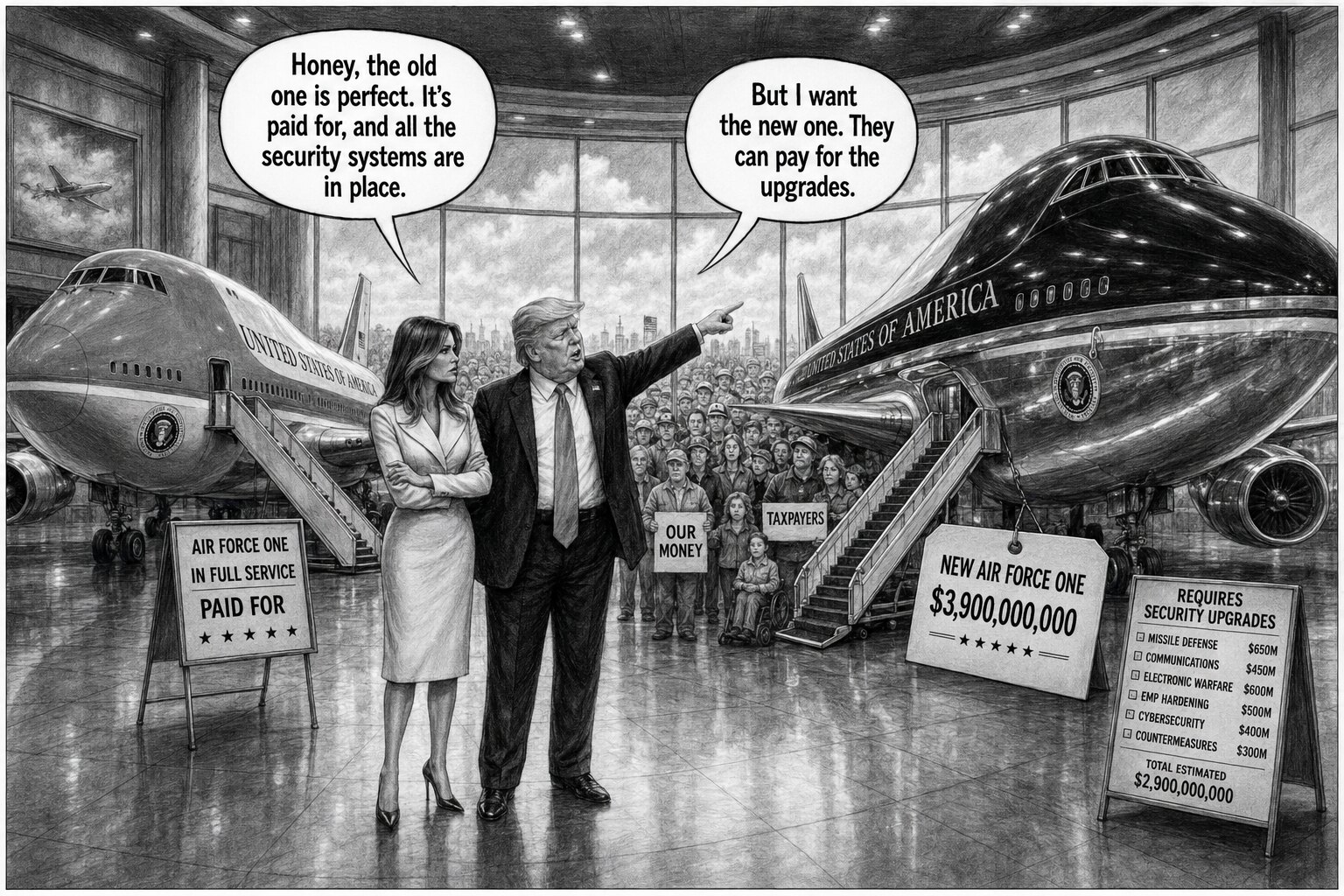
One additional correction matters because the Gulf governments are easily confused: the Boeing 747 accepted for presidential use came from Qatar, not Saudi Arabia.
None of these transactions proves that President Trump changed American nuclear policy in exchange for money. No evidence now on the public record establishes that specific quid pro quo. But the number, size, and timing of the official and private relationships create legitimate questions about conflicts of interest, transparency, and whether American foreign policy is being formed with sufficient independence.
Asking those questions is not a conviction. Refusing to ask them would be an abandonment of oversight.
The Questions Congress and the Public Must Ask
The strongest argument for American participation is that Saudi Arabia will pursue nuclear energy with or without the United States, and an American agreement may produce better inspections, stronger safeguards, more American jobs, and greater American influence than leaving the field to Russia or China.
That argument deserves consideration.
It still does not answer the central question: Why must Saudi Arabia enrich uranium domestically when it can purchase the fuel required to operate civilian reactors?
Before this agreement takes effect, Congress has an opportunity to review it under the Atomic Energy Act. The public deserves clear answers:
- Does the agreement permanently prohibit Saudi enrichment and reprocessing, or merely postpone them?
- If enrichment may occur later, who will own the facility, control the centrifuges, set enrichment levels, and possess the technical knowledge?
- Will international inspectors have full, continuing access to every relevant facility and material?
- What happens automatically if Saudi Arabia restricts inspections, withdraws from an agreement, or begins enriching beyond civilian levels?
- Will reactor fuel be supplied internationally, and will spent fuel be removed or placed under binding safeguards that prevent domestic reprocessing?
- Which American and Saudi companies will benefit, and will the complete financial terms be disclosed?
- What independent safeguards exist to separate the president’s constitutional responsibilities from the continuing Saudi business interests of his family?
A nuclear power station also becomes critical infrastructure that must be protected from missiles, drones, sabotage, cyberattack, theft, and terrorism. Those dangers can be reduced through engineering and security, but they cannot be treated as imaginary in a region that has repeatedly experienced attacks on oil fields, shipping, military installations, and civilian infrastructure.
The reactor is not the red line.
The capacity to enrich uranium is the red line.
Saudi Arabia is not Iran. Mohammed bin Salman has introduced social and economic reforms, Saudi intelligence cooperation has helped combat terrorist organizations, and the kingdom remains an important American trading and security partner. Iran and Saudi Arabia differ in their ideology, military relationships, proxy networks, and history.
But America’s responsibility is not to decide whether a present ruler is a friend. It is to decide whether creating a new enrichment capability will remain in America’s interest through every ruler, crisis, alliance, and war that may come during the next half-century.
We are not accusing Saudi Arabia of building a bomb today. We are not accusing President Trump of selling nuclear policy. We are placing documented facts on the table: the crown prince’s own nuclear statements, the American intelligence assessment concerning Jamal Khashoggi, Saudi Arabia’s record in Yemen, the history of shifting American alliances, the government agreements, the private financial relationships, and the unresolved provisions of the nuclear agreement.
Discernment belongs to the reader.
But civic responsibility requires the reader to look.
Once the facilities are built, the technical knowledge transferred, and the centrifuges begin to turn, America may no longer be able to undo what it helped create.
The time to ask questions is now.
Research Basis
1. U.S. Department of Energy, “United States and Saudi Arabia Reach Historic Nuclear Cooperation Agreement,” July 22, 2026. https://www.energy.gov/articles/united-states-and-saudi-arabia-reach-historic-nuclear-cooperation-agreement
2. Associated Press, “US and Saudi Arabia sign new nuclear agreement that could pave way for kingdom to enrich uranium,” July 22, 2026. https://apnews.com/article/15fdb262bb9c83d0d959ca96b7561c12
3. U.S. Nuclear Regulatory Commission, “Deconversion of Depleted Uranium” and uranium-enrichment background. https://www.nrc.gov/materials/fuel-cycle-fac/ur-deconversion
4. U.S. Department of Energy, “Beyond Oppenheimer: How Nuclear Weapons and Nuclear Reactors Are Different.” https://www.energy.gov/ne/articles/beyond-oppenheimer-how-nuclear-weapons-and-nuclear-reactors-are-different
5. U.S. Department of State, U.S.–United Arab Emirates Agreement Concerning Peaceful Uses of Nuclear Energy. https://2021-2025.state.gov/09-1217/
6. CBS News, Crown Prince Mohammed bin Salman’s 2018 statement concerning an Iranian nuclear weapon. https://www.cbsnews.com/news/saudi-crown-prince-mohammed-bin-salman-iran-nuclear-bomb-saudi-arabia/
7. U.S. Department of State, Office of the Historian, records concerning U.S. arms support for the Shah’s Iran. https://history.state.gov/historicaldocuments/frus1969-76ve04/summary
8. U.S. Department of State, Office of the Historian, President Reagan’s 1986 address concerning arms transfers to Iran. https://history.state.gov/historicaldocuments/frus1981-88v01/d281
9. National Commission on Terrorist Attacks Upon the United States, The 9/11 Commission Report. https://www.govinfo.gov/content/pkg/GPO-911REPORT/pdf/GPO-911REPORT.pdf
10. Office of the Director of National Intelligence, “Assessing the Saudi Government’s Role in the Killing of Jamal Khashoggi,” February 2021. https://www.dni.gov/files/ODNI/documents/assessments/Assessment-Saudi-Gov-Role-in-JK-Death-20210226v2.pdf
11. U.S. Department of State, Office of Inspector General, “Review of the Department of State’s Role in Arms Transfers to the Kingdom of Saudi Arabia and the United Arab Emirates,” August 2020. https://www.stateoig.gov/report/isp-i-20-19
12. White House, “President Donald J. Trump Secures Historic $600 Billion Investment Commitment in Saudi Arabia,” May 13, 2025. https://www.whitehouse.gov/fact-sheets/2025/05/fact-sheet-president-donald-j-trump-secures-historic-600-billion-investment-commitment-in-saudi-arabia/
13. White House, “President Donald J. Trump Solidifies Economic and Defense Partnership with the Kingdom of Saudi Arabia,” November 18, 2025. https://www.whitehouse.gov/fact-sheets/2025/11/fact-sheet-president-donald-j-trump-solidifies-economic-and-defense-partnership-with-the-kingdom-of-saudi-arabia/
14. Defense Security Cooperation Agency, proposed Patriot missile sale to Saudi Arabia, January 30, 2026. https://www.dsca.mil/Press-Media/Major-Arms-Sales/Article-Display/Article/4394629/kingdom-of-saudi-arabia-patriot-advanced-capability-3-missile-segment-enhanceme
15. U.S. Senate Committee on Finance, Affinity Partners investigation findings, September 25, 2024. https://www.finance.senate.gov/chairmans-news/wyden-investigation-of-kushner-firm-continues-new-letter-outlines-affinity-partners-fee-structure-lack-of-return-to-investors-questionable-deals-with-foreign-governments
16. Forbes, reporting based on Trump Bedminster’s 2022 income statement concerning LIV Golf revenue. https://www.forbes.com/sites/danalexander/2025/11/18/heres-how-much-trump-received-for-hosting-saudi-backed-golf-events/
17. Reuters, “Dar Global and Trump Organization launch $10 billion Saudi developments,” January 11, 2026. https://www.investing.com/news/stock-market-news/dar-global-and-trump-organization-launch-10-billion-saudi-developments-4440590
18. U.S. House Committee on Oversight and Accountability Democratic staff report concerning foreign-government spending at Trump businesses, January 4, 2024. https://oversightdemocrats.house.gov/news/press-releases/oversight-democrats-release-report-proving-trump-pocketed-millions-from-at-least
19. Congressional Research Service, “Nuclear Cooperation with Other Countries: A Primer,” updated February 10, 2026. https://www.congress.gov/crs_external_products/RS/HTML/RS22937.web.html
— Rollin E. Trueblood, USMC (Ret.)
Sources
The sources for this dispatch are still being added. Until they are here, treat the factual claims above as Ron's own account rather than as verified reporting.