CIVIC RESPONSIBILITY
Questioning Is Not Betrayal
During a recent Senate hearing, Secretary of Defense Pete Hegseth suggested that questioning this administration’s military policies amounted to failing to support America’s troops. I respectfully disagree.
I served in the United States Marine Corps and took an oath to support and defend the Constitution of the United States. Although my military service ended years ago, my obligation as a citizen did not.
I refuse to accept the idea that asking questions before America’s sons and daughters are sent into harm’s way is somehow dishonoring our troops. It is exactly the opposite. Every citizen has both the right and the responsibility to question the decisions that place our military in danger. That is not betrayal. That is one of the highest obligations of citizenship.
If you are not paying attention to the Senate hearings, I encourage you to do so. Listen carefully. Think critically. Ask yourself whether our elected leaders have clearly explained the mission, the strategy, the contingency plans, and the exit strategy before asking another American family to sacrifice someone they love. Our troops have fulfilled their oath. We must now fulfill ours by ensuring they are never placed in harm’s way carelessly, needlessly, or for reasons that cannot withstand honest public scrutiny.
Major Pete Hegseth served his country honorably. He deployed into combat, earned two Bronze Star Medals, the Combat Infantryman Badge, and other military commendations. Those honors were earned through courage, sacrifice, and service. I respect him for that service, just as I respect every American who has worn this nation’s uniform.
This story is not about questioning the courage of our troops.
It is about honoring them by protecting them.
Our military does not swear an oath to a president. They do not swear allegiance to a political party. They swear an oath to support and defend the Constitution of the United States. In return, they trust the American people to elect leaders who will exercise wisdom before asking them to risk their lives.
Many Americans believe patriotism begins and ends by standing during the National Anthem, placing a hand over the heart, or displaying the American flag.
Those things matter.
But they are only the beginning.
Our greater responsibility as citizens is to protect those who protect us. Before a single Marine, soldier, sailor, airman, Guardian, or Coast Guardsman is placed in harm’s way, we should demand that our elected leaders clearly explain the mission, define the military objectives, prepare contingency plans, and establish an exit strategy worthy of the sacrifices we ask our service members to make.
History reminds us why.
In Vietnam, success was frequently measured by enemy body counts. The prevailing strategy was one of attrition: inflict enough casualties and North Vietnam would eventually lose the will to continue fighting. North Vietnam adopted a similar philosophy in reverse. Its leaders believed they could endure enormous losses if they simply outlasted America’s political will. In the end, they proved correct. More than 58,000 Americans were killed, hundreds of thousands returned carrying physical and emotional wounds, and South Vietnam fell in 1975. Today, Vietnam is a nation with diplomatic and economic ties to the United States. The courage of our troops has never been questioned. The political strategy that guided the war continues to be. Every American has the right—and the responsibility—to ask whether the strategy matched the sacrifice.
Years later, America entered Iraq. Once again, our military performed with extraordinary courage and professionalism. Thousands of Americans lost their lives, tens of thousands were wounded, and the financial cost reached into the trillions of dollars. The principal justification centered on concerns about weapons of mass destruction, yet no active stockpiles were ultimately found after the invasion. Following the collapse of Saddam Hussein’s government, many historians and national security analysts argue that a regional power vacuum emerged, allowing Iran to expand its influence inside Iraq. Once again, the valor of our troops was unquestioned. The strategic decisions that sent them there continue to be debated.
Today, we should be asking equally important questions.
If military force is used against Iran, what are the long-term objectives? What defines success? What are the contingency plans if the conflict expands beyond Iran? What happens if China increases military pressure on Taiwan? What if North Korea opens another front on the Korean Peninsula? How will the United States sustain the conflict if it becomes regional? What is the exit strategy?
These are not partisan questions.
They are constitutional questions.
One modern example often cited for its planning was Operation Desert Storm. President George H. W. Bush assembled a broad international coalition, sought congressional authorization, explained the mission to the American people, and relied upon experienced military leaders such as General Norman Schwarzkopf to present the operational plan. Military objectives were clearly defined. Coalition forces understood the mission. Contingency planning existed before combat began. The American people knew why the nation was going to war and what success was intended to look like.
This brings us back to leadership.
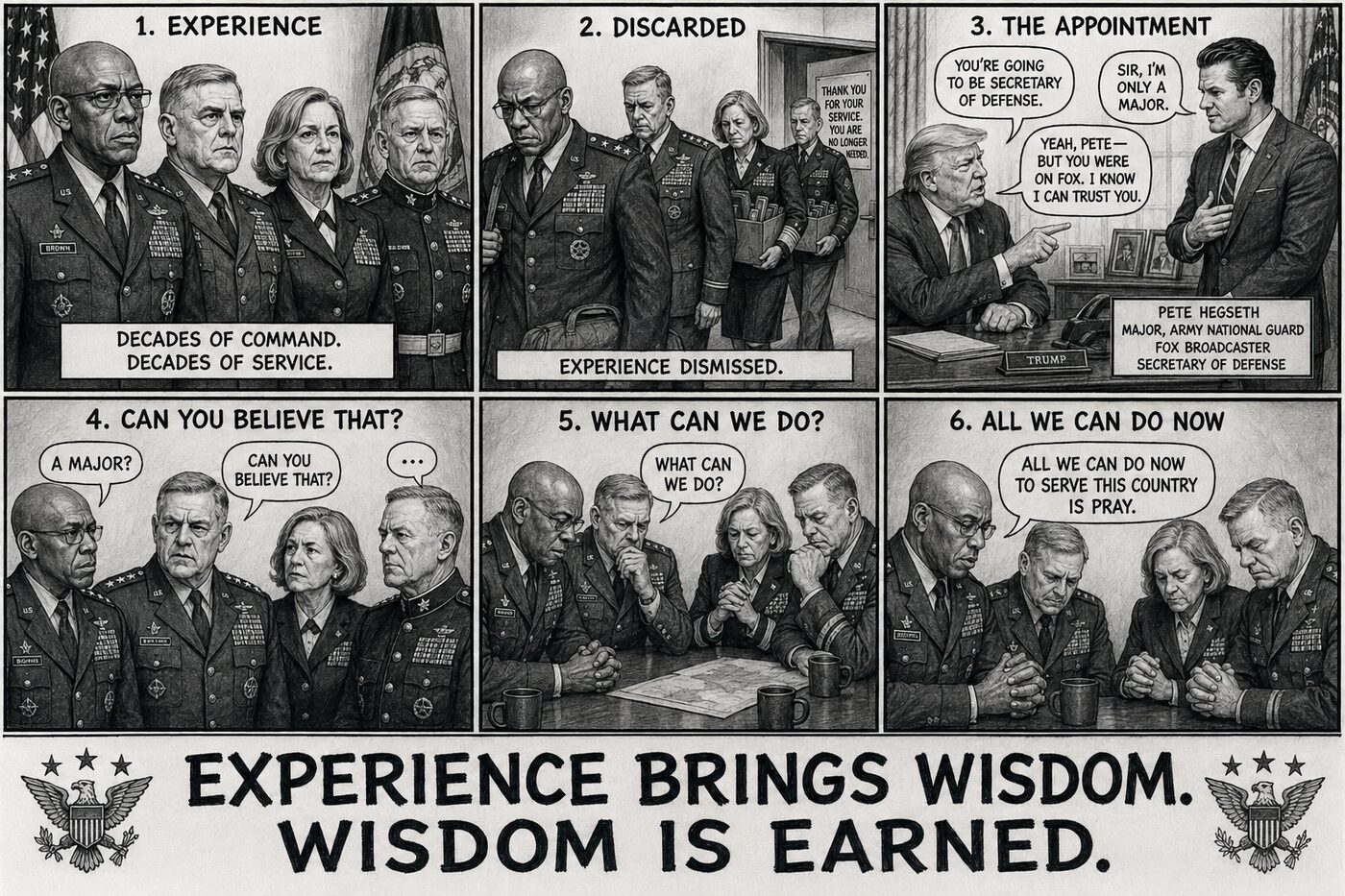
Major Pete Hegseth served honorably. No reasonable American should diminish that service. But serving with distinction as a major is fundamentally different from directing the defense of the United States and overseeing a global military enterprise. Strategic military leadership is developed over decades through repeated command, operational planning, joint assignments, coalition operations, logistics, intelligence integration, and advising civilian leaders during times of crisis.
As examples, several recently departed senior military leaders collectively represented well over a century of strategic military experience:
- General Charles Q. Brown Jr. — More than 40 years of service; Chairman of the Joint Chiefs of Staff; former Air Force Chief of Staff; combat fighter pilot and the President’s senior military adviser. - Admiral Lisa Franchetti — Nearly 40 years of service; Chief of Naval Operations; commanded carrier strike groups, numbered fleets, and major naval operations. - General James Slife — More than 35 years of service; Vice Chief of Staff of the Air Force; career special operations aviator with extensive operational planning experience. - Lieutenant General Joseph B. Berger III — More than 30 years of military service; senior military legal leader advising commanders on military law, operational authorities, and the law of armed conflict. - Lieutenant General Charles L. Plummer — More than 30 years of service; senior Air Force legal adviser responsible for military justice and operational legal guidance.
Whether one agrees or disagrees with personnel decisions made by any administration, the larger question remains: when leaders possessing generations of accumulated strategic knowledge depart, how is that experience replaced? Military strategy is rarely the product of one individual. It is strengthened by the collective judgment of leaders who have spent entire careers preparing for the most consequential decisions a nation can make.
I have never met a mother who wanted a folded American flag more than another birthday with her son.
I have never met a wife who preferred a medal to one more anniversary with her husband.
I have never met a grandfather who would trade one more afternoon fishing with his grandson for another name engraved on a memorial.
Our service members will continue to carry out lawful orders with courage, discipline, and honor.
The question is whether we, the citizens of the United States, will carry out ours.
Our responsibility is not merely to applaud our troops after the shooting begins.
Our responsibility is to stand watch before the first shot is fired.
Do not allow anyone—Republican or Democrat, commentator or politician—to persuade you that asking thoughtful constitutional questions is an act of disloyalty. Our troops deserve citizens who are informed, engaged, and willing to demand wisdom before sacrifice.
Questioning is not betrayal.
It is one of the ways free citizens protect those who stand in harm’s way for all of us.
May the scales fall off our eyes.
Addendum
There is another point that deserves careful consideration.
Following the U.S. strikes on Iran’s nuclear facilities in June 2025, President Trump publicly stated that Iran’s nuclear program had been “completely and totally obliterated.” Later, he stated that the facilities were effectively “entombed,” adding that only the United States or China would have the capability to recover what remained beneath the rubble.
If those public statements accurately describe the condition of Iran’s nuclear facilities after the strike, then the immediate nuclear threat cited as justification for military action would, by definition, have been eliminated.
That raises an important question for every citizen, regardless of political party. If the facilities were destroyed to the extent described, and if intelligence assessments before the strike indicated that Iran remained years away from producing a nuclear weapon, then Americans should reasonably ask whether an imminent nuclear attack on the United States truly existed at the time military force was authorized.
History also reminds us to be cautious about how success is measured during wartime. During the Vietnam War, military progress was frequently measured by body counts. Today, there is a danger of replacing one metric with another—measuring success primarily by the number of targets struck or facilities destroyed. Destroying targets may demonstrate military capability, but it does not, by itself, answer the separate question of whether entering or expanding a conflict was necessary in the first place.
As citizens in a constitutional republic, we owe it to those who serve, those who have fallen, and those who may one day be asked to fight, to distinguish between military success and the necessity of war itself. Those are two different questions, and both deserve honest answers.
— Rollin E. Trueblood, USMC (Ret.)
Sources
The sources for this dispatch are still being added. Until they are here, treat the factual claims above as Ron's own account rather than as verified reporting.
The cartoon