THE VILLAGES
We Live in the Bubble
What if the bubble gets burst?
Here in The Villages, we often refer to our community as “the Bubble.” We ride our golf carts, play golf and pickleball, listen to music in the town squares, and live relatively untouched by the violence occurring throughout the world. Wars are something we watch on television. The explosions are thousands of miles away. The flag-draped coffins arrive somewhere else.
But what if the war does not remain somewhere else?
The United States and Israel attacked Iran while negotiations over Iran’s nuclear program were still taking place. Iran presented a legitimate long-term nuclear concern, but the publicly available American intelligence did not show that Iran possessed a nuclear weapon or was preparing an imminent nuclear attack against the United States. Our own intelligence community reported that Iran could begin developing a militarily viable intercontinental missile before 2035—if its leaders decided to pursue one. North Korea, however, has already tested intercontinental missiles capable of reaching the entire United States.
The Strait of Hormuz was open before the war began. Approximately one-fifth of the world’s oil supply passed through it. Once Iran was attacked by the overwhelming technological superiority of the United States and Israel, it responded with the weapons it possessed: missiles, drones, militias, attacks against regional bases, and restrictions on shipping through the Strait.
That does not make every Iranian action legally or morally right. Attacking civilians, commercial vessels, desalination plants, or neutral countries cannot be excused simply because Iran was attacked first.
But we do not have to approve of Iran’s government to understand what any nation would do when attacked by a vastly superior military. It would attempt to survive. It would prolong the war, expand the cost, exhaust its enemy, and use every available weapon to make continued warfare politically and economically unbearable.
That should have been anticipated before the first American bomb was dropped.
At one documented point during the military buildup, 20 of the 49 United States Navy ships considered ready for military operations—41 percent—were positioned in or around the Middle East. Additional F-16 and F-35 fighters and dozens of refueling aircraft are now being sent into the region. By July 21, the Pentagon estimated that the war had already cost $37.5 billion, while requesting tens of billions more to replenish the military. At least 17 American service members had died, and more than 500 had been wounded.
The United States reportedly struck approximately 13,000 targets during the first six weeks of the war. Iran still did not surrender.
President Trump now faces the trap that has captured other presidents. As American casualties mount, admitting that the original decision was mistaken becomes increasingly difficult. Every new flag-draped coffin creates pressure to retaliate. More retaliation produces more Iranian attacks. Those attacks produce more American casualties, which produce demands for greater escalation.
Soon, we are no longer fighting to accomplish the original mission. We are fighting so those already killed will not appear to have died in vain.
But while our aircraft, ships, missiles, money, and attention are concentrated on Iran, our other adversaries are watching.
What if China decides this is the moment to blockade Taiwan?
China would not necessarily have to begin with an invasion. It could surround Taiwan with ships and aircraft, declare military exercises or an inspection zone, and gradually strangle the island’s trade. The United States would then face a terrible decision: attempt to break the blockade and risk a direct war between two nuclear powers, or stand back while Taiwan is forced to submit.
The American military would not be powerless. We remain the most capable military force in the world. But responding to China while sustaining a major war against Iran would divide our ships, aircraft, missile defenses, munitions, intelligence, logistics, and national attention.
What if North Korea crosses the 38th parallel again?
President Obama warned President-elect Trump that North Korea would be the most urgent national-security threat he inherited. Unlike Iran, North Korea possesses nuclear weapons and has successfully tested missiles capable of reaching the American homeland.
An invasion of South Korea would immediately threaten millions of civilians, approximately 28,500 American service members stationed there, and some of the world’s most important industrial facilities. The United States would again be forced to divide its forces while confronting an enemy capable of threatening American cities with nuclear weapons.
Then there is the Panama Canal.
What if a hostile power, proxy organization, cyberattack, act of sabotage, or deliberately obstructed passage closes the canal at the same time?
Approximately 5 to 6 percent of global maritime trade passes through the Panama Canal, and roughly 70 percent of that cargo begins or ends in the United States. Closing it would disrupt American commerce, increase shipping times and prices, and complicate the movement of military supplies between the Atlantic and Pacific.
China, North Korea, and whoever might threaten the Panama Canal would not even have to coordinate their actions. They would merely have to recognize the same opportunity.
The greatest danger is not any one of these possibilities.
The greatest danger is all of them occurring close enough together that the United States must choose which fire to extinguish first.
Meanwhile, Iran may adopt an increasingly destructive scorched-earth strategy. Oil fields, refineries, electrical systems, bridges, ports, desalination facilities, and pipelines could become targets. Iran may decide that if its government and country are to be destroyed, the region’s economy will be destroyed with them.
Bombing Iran into submission may sound simple from a television studio. Occupying it would be something else entirely. Iran is nearly four times the size of Iraq, has more than 90 million people, and contains mountains and terrain well suited for prolonged resistance. We might destroy its conventional military, but controlling the country could produce another decade—or longer—of insurgency, terrorism, casualties, reconstruction, and flag-draped coffins.
America could win every tactical engagement over Iran and still lose strategically by leaving three other doors unguarded.
Here in The Villages, the music would probably continue playing for a while. The golf carts would still move through the tunnels. People would continue dancing in the squares.
Then fuel prices would climb. Medicine and replacement parts would become harder to obtain. Retirement accounts would fall. Shipping would slow. Military families would receive knocks on their doors. Our grandchildren could be called to fight wars that began without a clear exit strategy.
That is when we would discover that the Bubble was never made of steel.
Before a president sends Americans into combat, he should be required to answer more than whether we can destroy the enemy’s military. He must explain why the war is necessary, what victory means, how we will leave, what it will cost, how many casualties are anticipated, and what happens if another adversary moves while our attention is elsewhere.
I took an oath to defend the Constitution. Those flag-draped coffins are not political decorations in my mind. They represent somebody’s son, daughter, husband, wife, father, mother, or friend.
The greatest responsibility of leadership is not simply knowing how to begin a war.
It is possessing the wisdom to foresee what may happen after it begins.
Research basis
2026 Annual Threat Assessment, Office of the Director of National Intelligence
CSIS naval force assessment
Associated Press reporting on Pentagon costs, casualties, and the escalation around the Strait of Hormuz
Americas Quarterly analysis of Panama Canal trade
— Rollin E. Trueblood, USMC (Ret.)
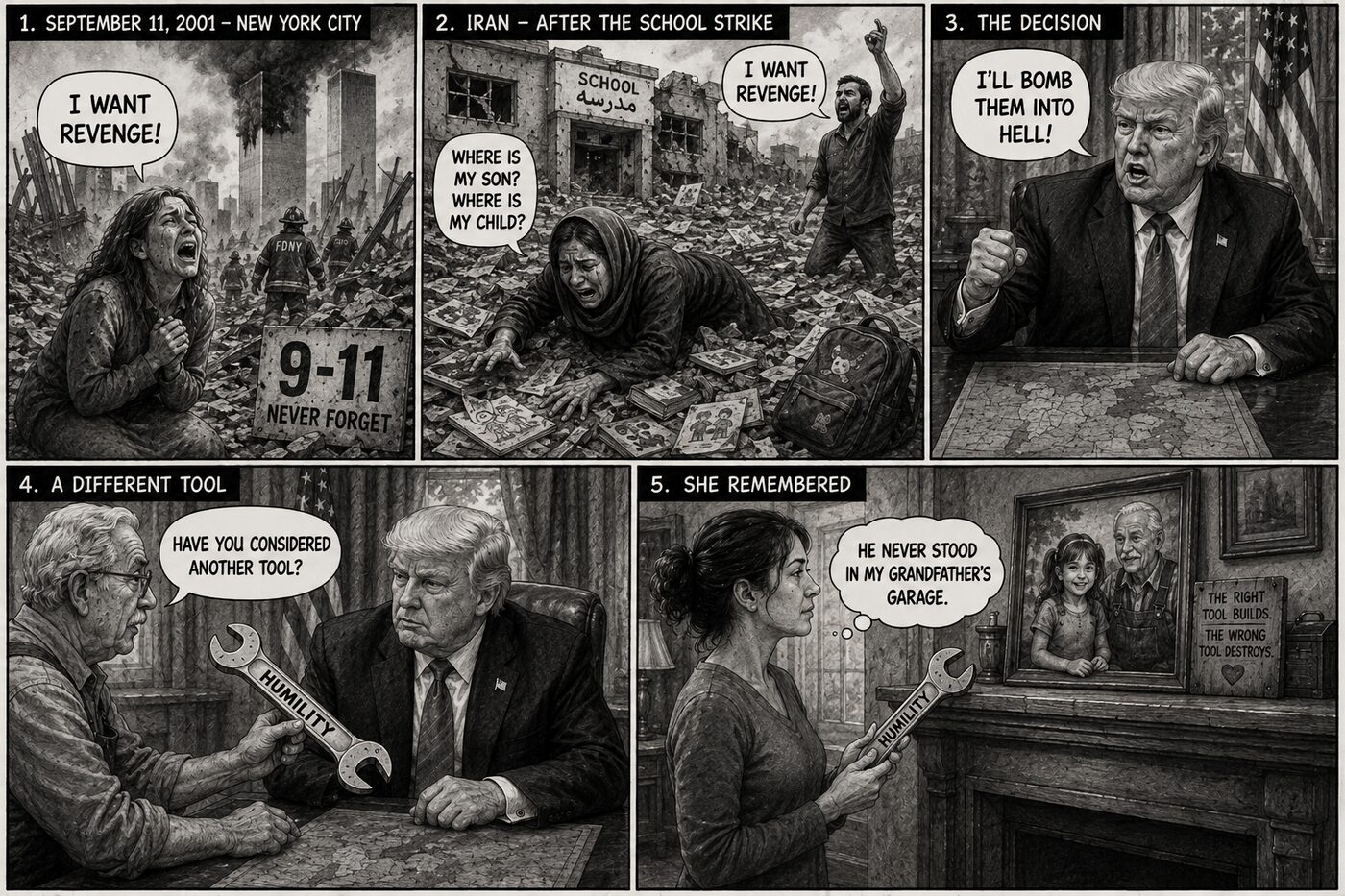
The cartoon