The Operator's Manual
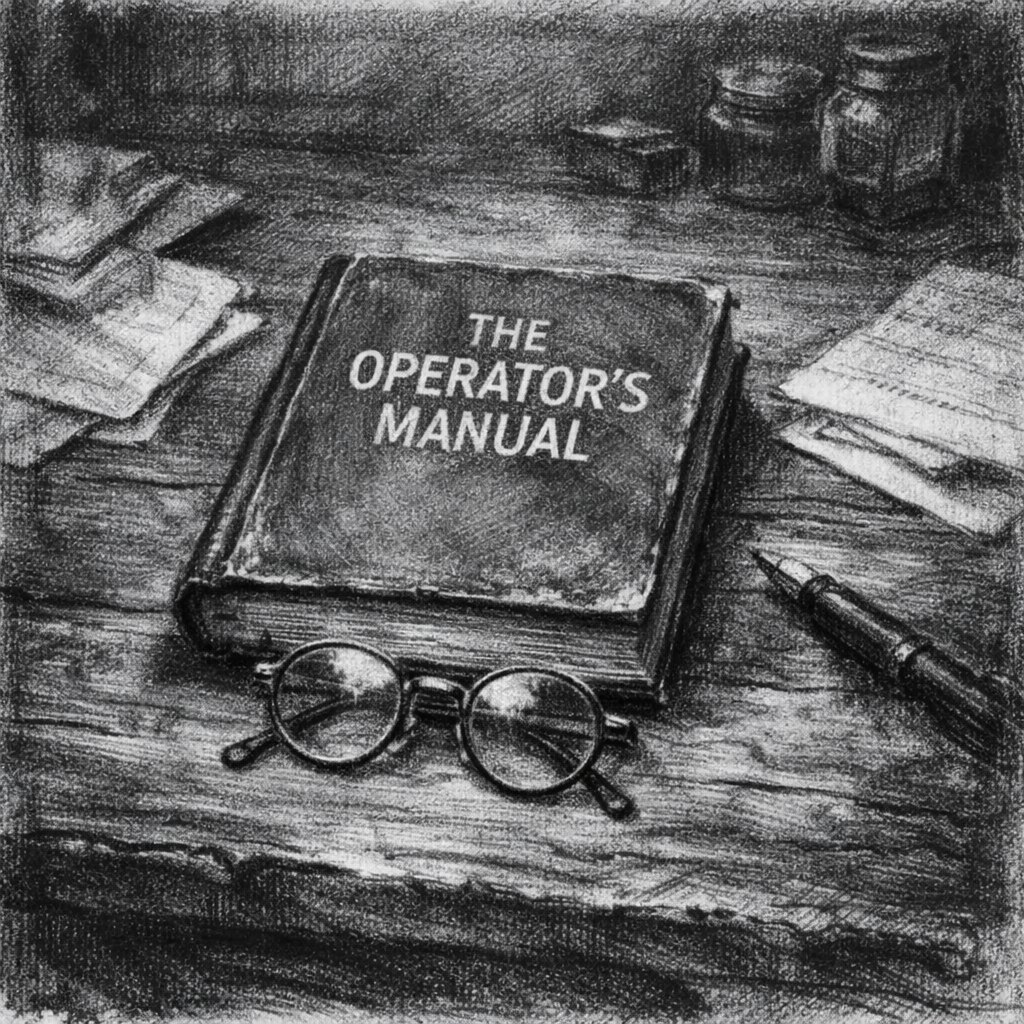
As I began writing this final chapter, I realized it could have had many different titles.
It could have been called Falling to the Basement. It could have been called Tearing Down Strongholds. It could have been called The Discipline of Life. It could even have been called The Book Is Filled with Wisdom, but I Still Failed.
All of those titles would have been appropriate.
But the title that fits best is this:
The Operator’s Manual.
When I first met Cheryl, I told her something half joking and half serious. I told her that if she wanted, I could come with an operator’s manual. I would be happy to write one for her.
Of course, life does not really work that way. You cannot hand someone a manual that explains how another human being works.
But the truth behind the joke was real.
If someone ever wanted to understand how I think, how I feel, how I process emotions, what matters to me, how to touch my heart, or how to get along with me, it would all be written in that operator’s manual.
In reality, every one of us comes with one.
But writing it requires something many people struggle to do.
You have to sit down and talk with each other. You have to listen carefully. You have to place the other person’s feelings into perspective. You have to absorb what they are saying and learn how they function.
And then comes the most important part.
You must have the discipline to implement what you learned.
Along the way Cheryl and I attended conferences for our business about safety and workman’s compensation. One example stayed with me.
A crew was framing a house. The second floor had been built, but one sheet of plywood had been left off where the stairwell would eventually go.
No barrier had been built. No caution tape had been placed. The floor was clean and swept.
But the hole remained.
At some point someone walked across that floor and stepped into that opening.
They fell straight through to the basement and struck the concrete floor.
The fall killed them.
I often used that example to explain something about life.
Sometimes in our lives we find ourselves down in the basement.
And strangely enough, there are things about that basement we enjoy. Moments where life feels the way we wish it would feel all the time.
But most of the time we walk around on the second floor.
Debating. Justifying. Arguing.
Occasionally one of us would step through that hole and suddenly we would find ourselves back in the basement again.
And there it was.
The life we both wanted.
Which leaves a question.
If that is where we wanted to be, why could we not simply build the stairs and walk down to it?
As I write this closing chapter, I wrestle with many thoughts. It may sound like rambling, but that is only because I am thinking as I write.
Earlier in the book I used the analogy of animals pulling a load.
You can switch a trotting pony and make it go faster.
You can whip a mule and make it plow harder.
You can kick a dog, and he will still sit on your back porch waiting for you.
People can survive hardship.
But what they cannot survive is having the essentials withheld.
You can demand from someone.
You can push them harder.
You can even mistreat them.
But you cannot withhold the nourishment that keeps a relationship alive.
Food. Water. Cherishing. Care.
Without those things a relationship slowly withers.
Whether it is a dog, a pony, a husband, a wife, or a grandchild, the truth is the same.
A relationship that is not fed and watered will eventually perish.
Which brings me to strongholds.
In biblical times strongholds were built to protect people during attack. Kings and queens would retreat to them for safety.
But the strongholds we build in our own lives are often different.
They are built from ego.
They are built from justification.
I told my grandchildren many times that most people struggle to be honest with themselves, let alone with someone else.
Very few people are willing to open their heart, examine what is inside, and put in chains the parts that do not belong.
That takes discipline.
It takes humility.
It requires kneeling before God, laying those imperfections at the altar, and asking Him to help you change them.
How do you tear down a stronghold?
First you admit it exists.
Admit when you are being defiant. Admit when you are being lazy. Admit when you are not being compassionate. Admit when you are not being kind. Admit when you are not investing in romance. Admit when you are not pulling your load.
You cannot tear down a stronghold if you refuse to admit it is there.
You tear it down with truth.
You tear it down with honesty.
You tear it down with sacrifice and submission.
You seek wisdom.
You seek the proverbs and the parables that help you chip away at that wall.
Lay it at the altar.
Invite the Lord in.
And slowly the stronghold begins to fall.
Life itself is full of contradictions.
There are seasons for work and seasons for rest.
Moments when we question everything we have done.
And moments when we know that the effort itself was necessary.
This book is filled with nuggets of wisdom and proverbs.
Yet I must admit something honestly.
Even with wisdom, success is never guaranteed.
There is a song called Anyway.
It teaches a simple lesson.
You can love someone your entire life and in a moment they may walk away.
Love them anyway.
A batter walks up to the plate knowing the odds of missing the ball are greater than hitting it.
Swing anyway.
And when you strike out, lay down the burden.
Give it to the Lord.
That is a lesson I still struggle with.
I carry my failures heavily because I search for what I might have done wrong.
I hate failure.
I hate defiance.
I hate realizing that I am not always the man I try to be.
But this is my operator’s manual.
This is how I walk through life.
I am a United States Marine.
I have told Cheryl many times that I would love her better than anyone ever could.
But this is how I work.
For my inability to be someone different, I am sorry.
And yet I stand on that ground not in defiance, but in the belief that if two people truly work together, they can succeed.
I believe with all my heart that two people can make it if they both submit to each other, work together, and search for answers together.
Do not give up on your relationship.
There are times when separation may be necessary. Addiction, abuse, or repeated betrayal may leave no other choice.
But many relationships fail for reasons that could have been solved.
This book began as something I wanted to write for my granddaughters.
Along the way, I taught myself.
Along the way, new stories appeared.
Along the way, life continued to evolve.
And it will continue to evolve.
There is something else that must be said.
As I have walked through life, there have been times when my own strongholds and justifications hurt people.
For that, I am deeply sorry.
I apologize to my father for my defiance as a child.
I apologize to Cheryl for my failures.
There are many others I should apologize to as well, far too many to name.
And there are also many people who helped guide me, encourage me, and shape the man I tried to become.
Some of them appear in these pages. Many do not.
Just tonight, as I finished writing this, I was invited to a Bible study.
The Lord took me by the hand and led me there like a little boy.
Inside that home were men and women who welcomed me and spoke openly about life and faith.
The lesson that night was about tearing down strongholds.
It moved me deeply.
It was the reason I woke up at three o’clock in the morning to finish writing this final chapter.
So to those who helped guide me in life—
Thank you.
And to those my strongholds have hurt—
With all my heart, I apologize.
One lesson life has taught me is this:
A lesser man grows bitter. A stronger man grows better.
So I continue trying.
And I leave you with this final thought.
Build your own operator’s manual.
Talk to each other.
Write things down.
Marriage vows are sacred and beautiful words spoken from the heart.
But an operator’s manual is different.
An operator’s manual is where two people decide how they will walk through life together.
Understanding each other.
Serving each other.
And fulfilling the mission together.
Nuggets of Wisdom
• Strongholds protect the very things we refuse to confront.
• Relationships cannot survive when nourishment is withheld.
• Discipline and honesty are the tools that tear down the walls we build around our hearts.
• Wisdom does not guarantee success, but it gives us the courage to keep trying.
• A lesser man grows bitter. A stronger man grows better.
Proverbs
Proverbs 3:5–6
“Trust in the Lord with all your heart and lean not on your own understanding; in all your ways submit to Him, and He will make your paths straight.”
Proverbs 4:23
“Above all else, guard your heart, for everything you do flows from it.”
Proverbs 27:17
“As iron sharpens iron, so one person sharpens another.”
This story has a workbook — how to use it with the person across from you, and the point of it. Read the workbook for The Operator's Manual · All the workbooks.