HISTORY
History Doesn’t Lie. Politicians Do.
The true cost of war is written in blood, debt, and outcomes
War is not a political game. It is a last resort—and it must always remain the last resort.
Place a few old history books on a desk. Open one to Vietnam, another to Afghanistan, and another to Iraq. The pages will not argue. They will not campaign. They will not ask for votes, defend reputations, or invent excuses. They will simply record what leaders promised, how many people died, how much money was spent, and what remained when the shooting stopped.
People justify their behavior. We all do it. Failed friendships and broken marriages often begin with somebody explaining why a harmful choice was necessary until the damage becomes impossible to repair. Nations do the same thing, except the consequences are measured in flag-draped coffins, grieving families, ruined cities, damaged economies, and debts passed to generations that never approved the war.
History does not tell us that every war is wrong. Sometimes a country invades another country and force becomes necessary to drive the aggressor out. History does tell us that war must have a truthful reason, a limited objective, an attainable end, and a direct connection to national defense. When those elements are missing, courage on the battlefield cannot rescue failed judgment in the capital.
Vietnam: The War That Did Not Accomplish Its Promise
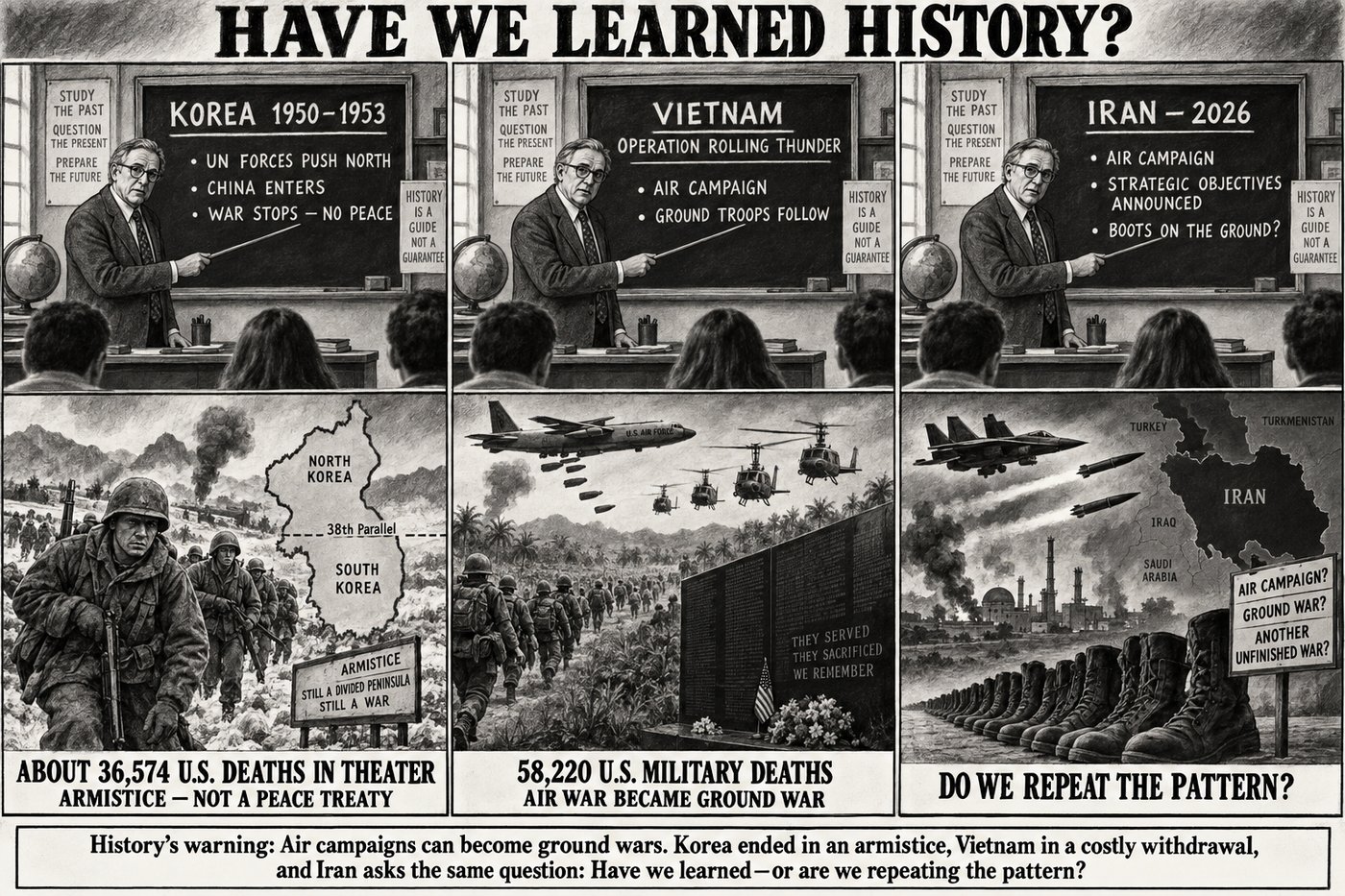
Years: Major U.S. combat, 1965–1973; Saigon fell in 1975 | Cost: About $168 billion then—more than $1 trillion in today’s dollars | Lives lost: 58,220 U.S. military deaths
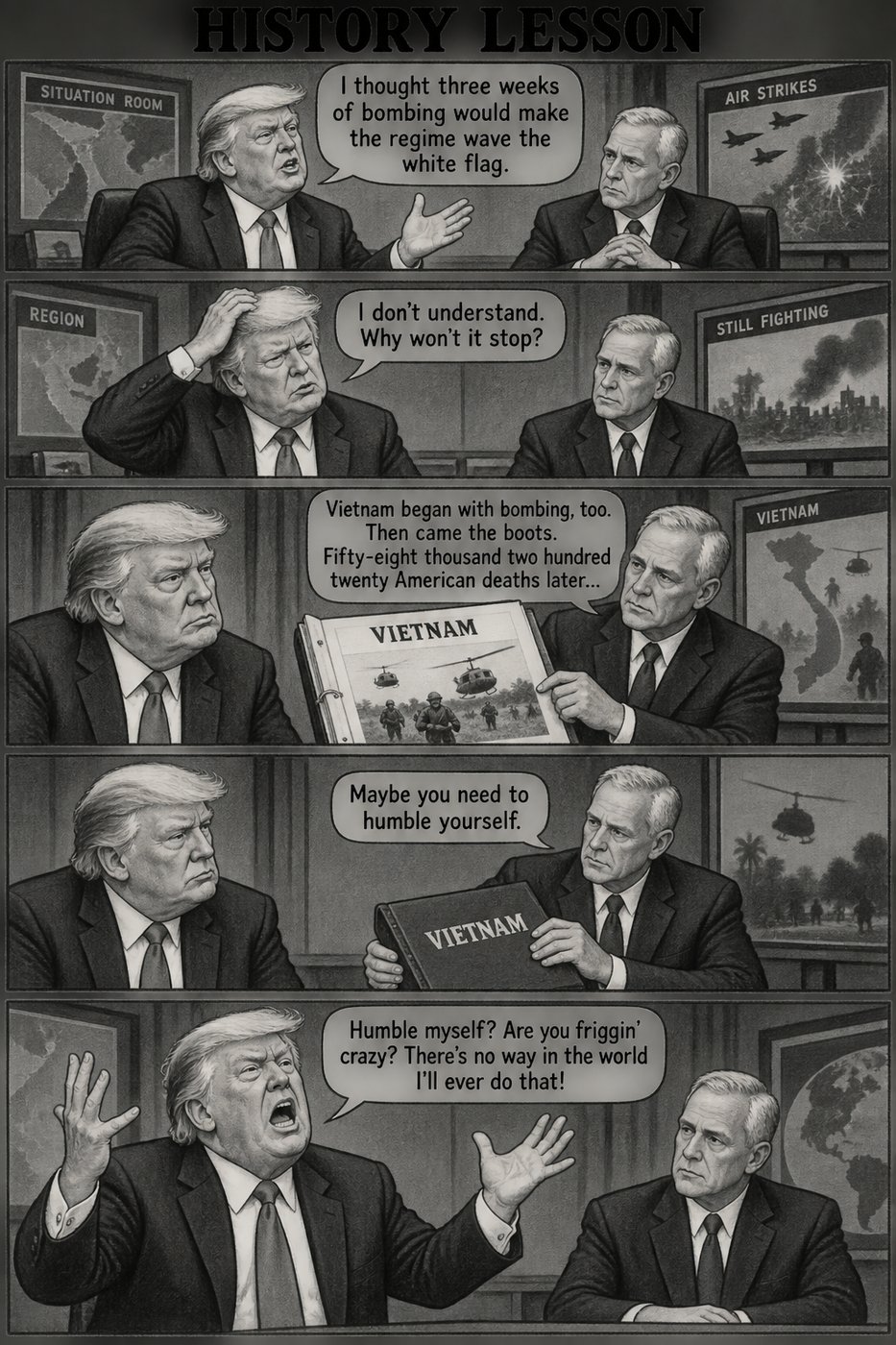
American leaders said communist expansion had to be stopped in Vietnam or it would spread throughout Southeast Asia. More than 58,000 Americans died, more than 153,000 were wounded, and countless others returned carrying injuries that were not yet understood.
The United States withdrew. South Vietnam fell. The country was unified under communist rule—the outcome America had spent years, lives, and treasure trying to prevent.
Today, Americans visit Vietnam for vacations. They walk through markets, stay in luxury resorts, and sit on beaches near Da Nang, where Marines once came ashore under combat conditions. Vietnam did not become the launching point for the collapse of the free world. It became a trading partner and tourist destination.
The courage of the men who served was not for nothing. They honored their oath and one another. But the political result for which they were sent was not achieved. The failure belongs to the leaders who placed them there without an attainable ending—not to the men who fought.
The Soviet Union in Afghanistan: Another Superpower Learns the Same Lesson
Years: 1979–1989 | Cost: Precise totals remain disputed; the burden helped weaken the Soviet state | Lives lost: 14,453 Soviet military deaths
The Soviet Union entered Afghanistan in 1979 to preserve a friendly government. It possessed aircraft, armor, artillery, and overwhelming technological superiority. Afghan fighters could not defeat the Soviet military in a conventional contest, so they prolonged the war with ambushes, difficult terrain, outside support, and the determination to outlast the occupying power.
After nearly ten years, the Soviets withdrew. The government they had supported collapsed. The Soviet Union itself dissolved less than three years later. Afghanistan had not conquered the Soviet Union; it had made the cost of remaining greater than the value of staying.
The Gulf War: A Clear Aggressor and a Limited Objective
Years: 1990–1991; major combat lasted about six weeks | Cost: $61.1 billion, much of it reimbursed by coalition partners | Lives lost: 148 U.S. battle deaths and 145 other in-theater deaths
In August 1990, Iraq invaded and occupied Kuwait. The aggressor and victim were clear. A broad international coalition formed around a defined objective: remove Iraqi forces from Kuwait and restore Kuwaiti sovereignty.
The coalition did that. It did not march to Baghdad, overthrow the Iraqi government, and attempt to rebuild the country. The war ended when its authorized objective was accomplished. That does not erase the lives lost or every later consequence, but it demonstrates what a limited military mission looks like.
The Falklands War: An Invasion Reversed
Years: April–June 1982; 74 days | Cost: Approximately £1.8 billion to Britain | Lives lost: 255 British, 649 Argentine, and 3 Falkland Island civilian deaths
Argentina invaded the Falkland Islands in April 1982. Britain sent a naval task force thousands of miles, defeated the occupying force, and restored British administration. The fighting was fierce and costly, but the central facts were unmistakable: territory had been seized, the invasion was resisted, and the campaign ended after the occupying army surrendered.
Afghanistan: A Necessary Beginning Becomes a Twenty-Year War
Years: 2001–2021 | Cost: About $2.3 trillion, including long-term obligations | Lives lost: More than 2,400 U.S. military deaths
After September 11, 2001, the United States had a legitimate reason to strike al-Qaeda and the Taliban government that sheltered it. The original purpose was directly connected to an attack against the American people.
But the mission expanded. Destroying terrorist camps became removing a government. Removing a government became building another. Building another became defending it indefinitely. Twenty years later, the United States withdrew, the Afghan government collapsed, and the Taliban returned to power.
The beginning of a war may be justified while its continuation becomes unjustifiable. A necessary response can still become an open-ended occupation when objectives multiply and leaders refuse to define an ending.
Iraq: The Weapons Were Not There
Years: 2003–2011, followed by renewed operations | Cost: Approximately $2.9 trillion for Iraq and related Syria operations and obligations | Lives lost: 4,418 U.S. deaths in Operation Iraqi Freedom; 31,994 wounded
The central public justification for invading Iraq was that Saddam Hussein possessed stockpiles of weapons of mass destruction that threatened the United States and its allies. Those stockpiles were not found.
The invasion removed a brutal dictator, but it also destroyed the structure holding the country together. Sectarian warfare followed. Al-Qaeda in Iraq grew into the organization that became ISIS. Iran gained influence throughout the Iraqi government and armed groups. America removed one of Iran’s principal regional enemies and created a vacuum that Iran helped fill.
A battlefield victory is not the same thing as a successful war. The United States defeated the Iraqi military quickly. It then spent years and thousands of lives discovering that overthrowing a government is easier than controlling everything that follows.
Russia and Ukraine: When Defense Is Necessary—and War Still Devours Nations
Years: Russia’s full-scale invasion began in February 2022 | Cost: Hundreds of billions in destruction and military expenditure | Lives lost: Military and civilian casualties continue to rise
Russia invaded Ukraine. Ukraine did not manufacture a theoretical danger and send armies into Moscow; Russian forces crossed Ukraine’s internationally recognized borders. Ukraine therefore possesses the clearest traditional justification for war: defending its people and territory from an invading army.
Yet a justified defense does not make war inexpensive or controllable. Cities have been damaged, families displaced, economies strained, and an entire generation marked by death and injury. The necessity of resisting invasion should make us more cautious about starting elective wars—not less cautious—because even justified wars unleash consequences no leader can fully command.
What the Record Teaches
The Gulf and Falklands wars had identifiable aggressors, limited military objectives, and recognizable endings. Vietnam, Afghanistan, and Iraq expanded around changing explanations, uncertain end states, and political leaders who repeatedly assured the public that progress was just ahead.
The lesson is not that America must never fight. The lesson is that force should be used to defend the United States, repel an invasion, protect a treaty ally from a clear attack, or stop a genuine and imminent threat when every reasonable alternative has failed. War should not be used to improve a president’s political standing, protect anyone’s reputation, test a theory, enrich connected interests, or solve a problem that diplomacy and containment can still manage.
The Ledger Since Vietnam
Counting Vietnam and the major American wars that followed, more than 65,000 American service members have died and more than 207,000 have been officially recorded as wounded—over 272,000 military casualties. Those figures do not fully count the veterans who returned with traumatic brain injuries, toxic exposure, permanent disability, post-traumatic stress, or wounds that did not become visible until years later. The names on the monuments represent only part of the price.
Financially, Vietnam, the Gulf War, the post-9/11 wars, and the present Iran war have cost or obligated the United States more than $9 trillion. Our gross national debt now stands near $39.5 trillion. If an equivalent $9 trillion had instead been applied dollar-for-dollar to that debt, it would stand near $30.5 trillion—approximately 23 percent lower. That is a simplified comparison, not a claim that every war dollar was borrowed. It demonstrates the opportunity cost: money consumed by war cannot also repair our infrastructure, strengthen the nation, care for veterans, reduce interest costs, or remain with the people who earned it.
The Next History Book
Iran makes the next chapter even more dangerous. Iran is nearly four times larger than Iraq geographically and has roughly twice the population. Its mountains, enormous territory, missiles, drones, regional allies, and position beside the Strait of Hormuz make it capable of prolonging a conflict even though it cannot match American technology. What begins as an air campaign can become attacks throughout the region, disrupted oil supplies, American casualties, demands for retaliation, and eventually another war measured in years rather than weeks.
And this time we must face an uncomfortable fact: Iran did not invade the United States. The United States and Israel launched the opening attack on February 28, 2026. In the ordinary meaning of the word—not as a formal legal judgment—this time we are the aggressor. That does not excuse every Iranian retaliation. It does mean that we cannot pretend America is merely driving an invading army from its soil. We chose to begin the military action, and history tells us how rarely leaders can control what happens after the first bombs fall.
By July 21, the Pentagon estimated that the Iran war had already cost $37.5 billion. At least 18 American service members had been killed and hundreds wounded. Those numbers will not be the final figures if the war continues. Each new casualty will create political pressure to retaliate, and every retaliation will give Iran another reason to widen the conflict. That is how a limited operation becomes a war without a limit.
War is not a political game. It is the final failure of every other option, and it must always—always—remain the last resort.
History doesn’t lie. Politicians do. Open the history book before allowing them to open another war.
Principal Sources and Data Notes
Casualty definitions differ among agencies and conflicts. The aggregate ledger is deliberately conservative and covers the major wars discussed in this story. Current Iran figures and the national debt are snapshots through July 21–22, 2026 and will change as events continue.
- National Archives — Vietnam War U.S. Military Fatal Casualty Statistics
- Congressional Research Service — American War and Military Operations Casualties
- Brown University Costs of War — Post-9/11 budgetary costs
- Brown University Costs of War — U.S. budgetary costs of the post-9/11 wars
- U.S. Treasury Fiscal Data — Debt to the Penny
- Associated Press — Iran war escalation and its February 28 opening attacks
- Associated Press — Pentagon estimate of $37.5 billion for the Iran war
- Associated Press — U.S. service member death toll in the Iran war
- World Bank — Iran and Iraq country data
— Rollin E. Trueblood, USMC (Ret.)
The cartoons